NEWS AND VIEWS FROM THE GREEN PARTY IN THE LONDON BOROUGH OF BRENT

16 Aug 2011

Brent cyclists invited to meet Jenny Jones

Jenny Jones, Green Party candidate for the London mayoral elections,  will be coming to Brent on Friday to meet cyclists and investigate with them how cycling could be improved.

Her visit will start at Wembley Stadium station at 10am on Friday August 19th where anyone interested should come and meet her. She will then be able to cycle to any spots in the borough which give cyclists particular difficulties.

Could everybody who decides to come respond to Collette.Bird@london.gov.uk with their telephone number in case of any emergencies or delays.

8 Aug 2011

Council must provide leadership and resources to combat climate change

The Brent Green Party has submitted the following in response to the Council's consultation on the Green Charter:

A. Brent Green Party welcomes the initiative of Brent Council in opening up for consultation a proposed Green Charter. Unfortunately, we do not find that the current draft goes far enough and with appropriate sense of urgency in promoting or facilitating the lifestyle and social change that is required for the Borough of Brent to make its full and due contribution in meeting the challenge facing the world of reversing the present rapid deteriorating world environment, integral with which is the phenomenon of man-made global warming. This latter which, if not faced head on and forthwith at all levels, is likely to result in a largely uninhabitable planet within the life-time of children being born today.

B. Brent Green Party’s response here is directed towards the kind of radical, joined-up social and political change that should be aimed at all levels of society. The current draft is not sufficiently ambitious in this regard and needs to convey the need for a holistic approach in all aspects of human activity - energy efficiency in the home, localisation of food production, the development of habitable spaces which take into account the long term impact of transport policy and construction. Whilst we take education to be at the heart of this agenda, we also recognise that good policy has the power to shape individual and social action of the right kind, to make it easier for people to do the right thing and take local initiatives that spread good practice and ideas. The local transition towns initiatives in Brent are of just this inspiration. In contrast, the policy decisions taken by the current administration on the Civic Centre bring into question their recognition of the scale of the challenge represented by, in particular, climate change and the need to meet this challenge in the shortest practicable time-scale.
C. Our proposals below focus around investment in long-term jobs in green industry and services, as part of a package of Green New Deal solutions. The Green Charter as presently formulated puts the onus on residents to take action, which is a necessary part of the equation, but neglects the role of the local authority in providing both strong committed leadership and the resources necessary to implement real change. We ask Brent to build into its Charter the following programme:

1. The Council to implement a systematic programme of high quality roof and wall insulation, double-glazing and draught exclusion in its social housing sector.
2. The Council to make a street-by-street offer to private residents/tenants of a similar programme reducing the cost through economies of scale.
3. The Council to work with local colleges to provide training/apprenticeships in green technology.
4. The Council to provide incentives to local business to reduce excess packaging at source and to recycle waste
5. The Council to provide incentives for green businesses to locate in Brent, particularly in the regeneration areas.
6. The Council to extend the 're-use' aspect of recycling at local recycling plants by means of a warehouse to store household goods and furniture that can be re-used by residents and retailers for onward trading.
6. The Council to work with schools on making their buildings energy efficient and adopting 'green' curriculum which would see pupils as agents in the education of parents as well as giving them a role in managing the school environment in a sustainable way. This to be launched through a Climate Change And Education Conference open to teachers, student groups, governors and green community organisations.
7. The Council to set aside land in larger parks for community allotments and on under-used land such as railway embankments, derelict building sites and common areas on estates. The Metropolitan Housing allotments on the Chalkhill estate are a good example.
8. The Council to set aside land in parks for wildlife conservation and encourage schools to set up wildlife gardens

D. We reiterate our well-known opposition to the new Civic Centre on the grounds of its affordability and that its 'green credentials' have not taken into account the environmental costs of the raw materials, manufacturing and construction necessary to deliver the completed building.

E. At a more general level, Brent Green Party supports the One Planet Living Framework developed by BioRegional and WWF with the objective of helping people and organisations live and work within a fair share of our planet’s resources. We suggest this framework would be an excellent point of reference for drawing up the next draft of the Brent Green Charter.

In particular, we draw attention to the following important general objectives in formulating particular relevant proposals applicable to the Borough of Brent:

1.  Making buildings more energy efficient and delivering all energy with renewable technology.
2.  Reducing waste, reusing where possible, and ultimately sending zero waste to landfill.
3.  Encouraging low carbon modes of transport to reduce emissions, reducing the need to travel.
4. Using sustainable healthy products, with low embodied energy, sourced locally, made from renewable or waste resources.
5.  Choosing low impact, local, seasonal and organic diets and reducing food waste.
6.  Using water more efficiently in buildings and in the products we buy, tackling local flooding and watercourse pollution.
7. Protecting and restoring biodiversity and natural habitats through appropriate land use and integration into the built environment.
8.  Reviving local identity and wisdom and supporting and participating in the arts.
9.  Creating bioregional economies that support fair employment, inclusive communities and international fair trade.
10. Encouraging active, sociable, meaningful lives to promote good health and wellbeing.

22 Jul 2011

Wasted Authorities: Threat from Pinkham Way Waste Plan

Installation Art in Lincoln Inns Field, July 2011. (photo: S Ali)

On 21 July 2011, the local Green Parties of Enfield, Haringey and Barnet organised a public meeting to raise awareness of the threat to health, environment and well-being posed by the North London Waste Authority’s plan to build an industrial scale waste plant at Pinkham wood.

Quentin Given, Coordinator of Tottenham and Wood Green Friends of the Earth, began with an overview of the kind of things we needed to be doing to reduce the amount of waste we produced as individuals and to take greater responsibility for its destiny in society. He made several excellent points, focusing on how overconsumption was the key illness that needed to be diagnosed and how goods needed to be built to last instead of turned over to the scrap heap.

Colin Parish, a local resident and founder of The Pinkham Way Alliance, spoke from the heart about how he first got involved in the campaign, almost as an unlikely activist, let alone somebody who had ever thought about green issues in the past. He spoke of his deepening understanding of the interconnectedness of things, and in particular the impact upon the planet of so much of human activity we took for granted, but needed to abate, such as supermarket packaging. He spoke about his desire to be able to enjoy his garden, free from fly infestation that would accompany such an industrial scale waste plant in his neighbourhood, and determination to see any future grandchildren be able to do the same, and to be able to visit the Pinkham Wood site as a place of beauty and nature. He spoke about the use of lawyers in the campaign and the need to be prepared to fight in the courts, as and when necessary, at every step – because of the intolerable impact such a plant would have on air pollution and huge lorries coming in and out of the plant, serving seven London boroughs.

Darren Johnson, Green London Assembly member, commended the campaign on its recent success in getting Haringey to postpone the NLWA waste application until the NLWA plan is completed. He spoke about the basic flaws in the waste plant proposal as a method of bringing together so much waste from seven boroughs without concerted action on improving the recycling regime, by introducing organic waste collection, for example. He spoke about the need to fight at every step, how the Greens would be with them every way, and the pressure that would need to be brought to bear on City Hall and the mayor.

Quentin Given (FoE), Darren Johnson AM (Green Party), David Bennie (Chair), Colin Parish (Pinkham Way Alliance)

All the contributions were eloquent and well informed. The contributions from the floor were also to the point and often attempted to address the broader context. Anne Gray spoke about the need for legislation to make it easier for businesses to be able to recycle without prohibitive charges. Laura Davenport spoke about her incredulity that whilst seven boroughs could get together to produce a dull, lengthy waste plan, they could not yet produce a plan to implement, what would be far better, consistency of best practice in recycling streams across the boroughs.

Colin Parish struck me as quite an inspirational figure. The local community will require leaders like that to come forward, to rise to the challenge. He even quoted Churchill, with the qualification (rightly) that he didn’t agree with everything he did or said, “Don’t do your best, do what is necessary.”

Just one thought I was left was the ridiculousness of co-ordinating waste across boroughs in this way. Brent is facing its own challenges up ahead, as part of the West London Waste Authority (see my colleague, Martin Francis's excellent updates here and here). There seems to be an inbuilt assumption amongst contractors bidding for tenders that they can make good on the profit motive by economising on scale, irrespective of whether this is good for the planet. Coordination must not come at the cost of proper appraisal of how to take responsibility for our waste locally.

Haringey Green Party report on the meeting here.

20 Jul 2011

Soapbox: Unaffordability and Undesirability of £100m Brent Civic Centre

Here is a recording of the soapbox I gave at the Kingsbury and Kenton Area Consultative Forum on 19 July 2011, entitled "The unaffordability and undesirability of the Civic Centre Behemoth". On the day that the people of Brent found it necessary to take Brent Council to the High Court for library closures, I was entitled to call a spade a spade:


In reply to me, Leader Ann John said that it was unremarkable for the savings figures to change on a monthly basis and that these figures were already in the public domain. Unfortunately, this assertion contradicts the statement made by the Asst Director for the project, Aktar Choudhury on 14 July 2011 that he could not release the figures due to "confidentiality". I await the result of my FOI request, which Brent has already acknowledged receipt of. Following the three-personed sales-pitch on the Civic Centre, two out of four residents who asked questions from the floor focussed on the same concern about unaffordability of this project.

Picture of S Ali by P Murry, taken at an earlier lobby of Council Executive on 11 April 2011.

19 Jul 2011

People of Brent versus Brent Council: Save our Six Libraries

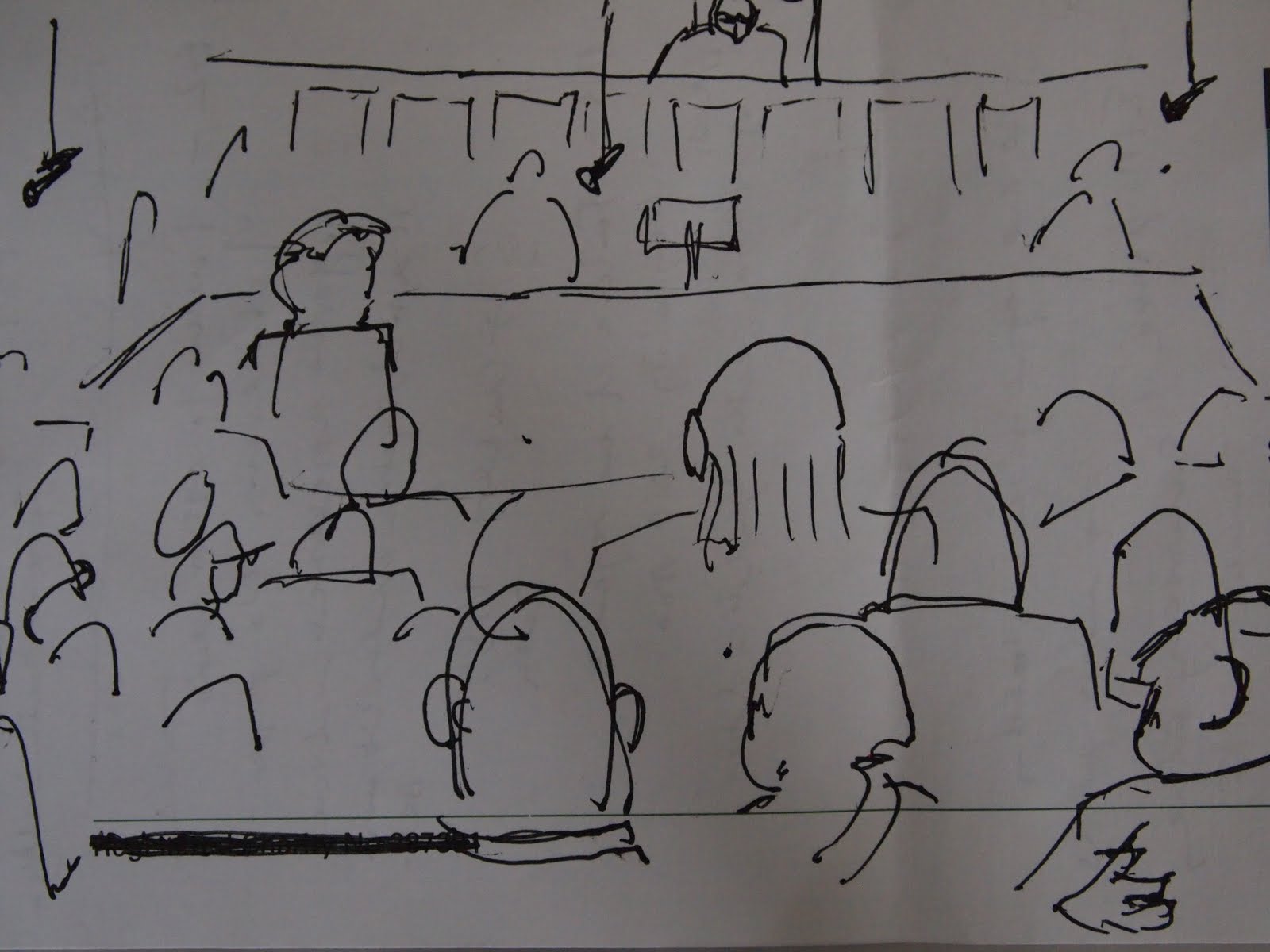
Sketch of Court 2, Royal Courts of Justice - The people of Brent versus Brent Council. (S Ali)

As significant as the goings on in Westminster on 19 July 2011 (hackgate hearings), at least for the good people of Brent, is the High Court challenge to the Council's plan to axe six local libraries in Brent - and the potential repercussions if the case is won. On the opening day of the legal challenge, the BBC reports.

In the words of the Save our Six campaign, the basis of the challenge is that: "Brent Council has closed its mind to alternatives to closure, did not assess community needs or the impact of closure properly, made significant mistakes about the facts, misunderstood its legal duty to provide a library service and acted unfairly."

After presenting a physical and vocal presence outside the entrance to the Court (some pictured below), the people of Brent packed the lower and upper public gallery of Court 2. The judge first entertained an application he had lately received to have the case adjourned, on behalf of a third party. This struck me as a desperate attempt at sabotage, which could only have helped the Council, and the judge rightly dismissed as "too late".

Counsel for the claimaint (the campaign to save the libraries) then summarised, in the first hour, the main legal arguments that she would go on to put in more detail. The contention was that "Brent had not acted lawfully, or with due regard, to its statutory duties." The main pieces of law referenced were the Public Libraries and Museums Act 1964 (in particular section 7): "It shall be the duty of every library authority to provide a comprehensive and efficient library service for all persons desiring to make use thereof ..". Also referenced were the Equalities Act 2010 and the Childrens Acts of 1989 and 2004.

We were introduced to a compelling case that the Council, in deciding how to fulfil its duty under the 1964 Act, "had fixed on the means of fulfilling that end, without proper, open-minded consideration of the alternative options." These failures were itemised under the headings of failures of Approach - such as closing its mind to third sector collaboration - and failures of Analysis. The latter included the contentions that Brent Council had sought to reach a decision before facilitating the formation of rational and informed views; had failed to rigorously assess the needs of children; and had turned its Equalities Impact Analysis in to a piece of advocacy "rather than a genuine tool to inform the decision-making process."

The final piece of the legal challenge concerned Brent's inadequate consultation .. because "Brent closed its mind"; did not offer consultees financial alternatives; made up criteria without disclosing them to consultees; and offered no questions about what would mitigate the library closures. These charges will ring true to anybody who is familiar with Brent's attitude to consultation generally, and the libraries problem in particular. (Report of original Council decision on 11 April 2011 to decimate libraries.)

I shuffled a written note to a neighbour in the gallery concerned that Council representatives (for the defendant) appeared to her to be visibly making light, or in denial, of some of these grave criticisms. "We will prevail!" I replied.

Another resident, Andria Greaves, said to me of her local library in Tokyngton: "It's one of the very far out libraries which they think they can ignore."

Over the coming hours and days, let Brent Council's mind be focussed to its rank disdain of the people of Brent and its riding roughshod over the educational needs of some of its most vulnerable communities.

The people of Brent will not be ignored!

Brent library campaigners outside the High Court.